Comprehensive Engineering & Advisory Services
From NDT diagnostics and structural certifications to condition assessments and restoration — the full spectrum of civil engineering consultancy, under one roof.
Engineering & Advisory Services
Each service listed below can be expanded to reveal full scope, methodology, and key deliverables. Click a service card to learn more.
Quality Audit & TPQM
Third-Party Quality Monitoring and independent construction phase inspections to prevent structural flaws from day one.
Independent quality auditing and third-party monitoring that runs alongside the project from initial planning to final handover. We verify material compliance, reinforcement layout details, shuttering parameters, concrete pouring practices, curing durations, and finishing standards at every stage — ensuring civil engineering works match approved blueprints, public regulatory norms, and international safety codes, and helping clients catch costly structural flaws before they become embedded in the structure.
Pre-Construction Planning Review
Design drawings, material specifications, and quality control plans reviewed before work begins on site.
Independent Stage Sign-Offs
Verifications of formwork stability, reinforcement placements, cover space, and embedments before concrete pours.
Process Compliance Audits
Monitoring batching, concrete mixing ratios, water-cement ratios, workability, and placement practices on site.
Laboratory MoU Support
Immediate concrete cube curing and laboratory compressions in associated NABL-accredited labs.
Defect Mitigation & Reporting
Real-time reports and technical checklists issued to construction site teams to correct execution errors early.
Final Handover Quality Sign-Off
Consolidated audit trail and compliance certification delivered at project completion.
Structural Auditing & Stability
A staged structural evaluation process — from visual inspection to code-based analysis — certifying the safety of existing buildings and infrastructure.
A structured, multi-stage evaluation of existing structures, from visual inspection and non-destructive diagnostics through to detailed investigation and analytical verification. We combine field data, laboratory testing, and sound engineering judgement to certify structural soundness, map deterioration, and, where required, verify load-carrying capacity through code-based structural analysis.
Visual Inspection
On-site visual survey to identify surface distress, deflection, and early warning signs of structural degradation.
Structural Diagnostics (NDT)
Non-Destructive Testing methods applied to assess internal structural condition without damaging the element.
Engineering Judgement & Scientific Assessment
NDT findings are analyzed and interpreted through sound engineering judgement to form a scientific structural opinion.
Evaluation of In-Situ Concrete Quality
Concrete quality and strength assessed in-situ using UPV and rebound hammer — explore the methods below.
Detailed Structural Investigation
Verification through core sampling, laboratory testing, carbonation depth, chloride analysis, and petrographic analysis wherever required.
Structural Analysis (if required)
Analytical verification of load-carrying capacity, serviceability, and structural safety using engineering software and code-based assessment.
Condition Assessment
Comprehensive condition surveys of existing structures using visual inspection and advanced diagnostics to detect deterioration before it compromises safety.
Assess the physical and functional condition of existing buildings and infrastructure through systematic visual surveys, non-destructive testing, and advanced diagnostic techniques. We investigate distress patterns and deterioration mechanisms, and uncover hidden defects, to help clients plan timely repairs, prioritize maintenance, and safeguard structural longevity.
Condition Assessment Survey
Systematic evaluation of cracks, spalling, corrosion, dampness, leakages, deflection, settlement, and other visible signs of deterioration.
Non-Destructive Testing (NDT)
In-situ evaluation using UPV, rebound hammer, half-cell potential, cover meter, and other NDT methods.
Investigation of Deterioration
Identification of corrosion, carbonation, chloride ingress, sulphate attack, water leakage, and concrete distress mechanisms.
Advanced Diagnostics
Evaluation using thermal imaging, drone surveys, moisture detection, and digital documentation to identify hidden defects.
Restoration & Rehabilitation
Retrofitting specifications including carbon fiber wrapping, micro-concrete jacketing, and pressure epoxy grouting.
A need-based repair process that moves from root-cause diagnosis to scheme design and hands-on execution. We specify solutions like micro-concrete column jacketing, carbon fiber reinforced polymer (CFRP) structural wraps, section enlargement, and chemical concrete injections to restore compromised structural safety factors and extend service life.
Damage Diagnosis & Root-Cause Analysis
Identifying the deterioration mechanism — corrosion, cracking, or spalling — before selecting a repair strategy.
Repair Scheme Design
Selecting the most suitable technique based on load conditions, exposure, and extent of damage.
CFRP Column & Beam Wrapping
Applying high-strength carbon wraps to columns/beams to boost shear and flexural capacities.
Micro-Concrete Jacketing
Applying specialized non-shrink micro-concrete layers to reinforce cracked nodes.
Pressure Epoxy Grouting
Injecting low-viscosity resins into cracks to seal concrete and restore load paths.
Corrosion Protection & Verification
Electrochemical rust inhibitor coatings applied and repairs verified before handover.
NDT Diagnostics
Advanced non-destructive concrete tests including UPV, rebound hammer, carbonation depth, and core compressions.
Try Interactive NDT ExplorerA layered diagnostic sequence that verifies concrete homogeneity, strength, and corrosion risks without damage. In association with Civilone Research Center Pvt Ltd (NABL Accredited), we move from broad ultrasonic screening through surface hardness readings, chemical profiling, and targeted core extraction to a single consolidated report.
Preliminary Screening (UPV)
Ultrasonic Pulse Velocity scanning sends ultrasound signals through elements to trace internal voids, honeycombing, and deep cracks.
Surface Hardness Testing
Rebound hammer readings taken across the element grid to estimate initial concrete compressive strength.
Carbonation & Acid Profiling
Measures alkaline loss depth in structural elements to detect rebar corrosion vulnerabilities.
Targeted Core Extraction
Extracting concrete cylinder cores from critical zones to execute direct laboratory compression crush checks.
Data Correlation & Reporting
Results from all methods cross-verified and consolidated into a single diagnostic report.
Testing of Building Materials
Certified material diagnostics covering rebar tensile bounds, concrete cubes, soil pH levels, and water purity.
A structured laboratory workflow that verifies material strength against target structural design tolerances. From site sample collection through to certified reporting, our testing capabilities cover concrete crushing analysis, tensile load testing for structural steel rebars, aggregate sizing compliance, and chemical analysis of site mixing water or soil backfills to identify corrosion threats.
Sample Collection & Identification
Representative rebar, concrete, soil, and water samples collected from site as per code requirements.
Steel Rebar Tensile Tests
Yield strength, ultimate elongation, bend, and rebend validations of structural steel rods.
Concrete Compressional Tests
Direct mechanical load crushing of standard concrete cubes to evaluate compressive grades.
Soil & Water Chemistry Assessments
Testing pH, sulfate contents, and chloride levels in foundation soils and site water to flag chemical attack risks.
Aggregate Size Verifications
Sieve mapping of coarse/fine aggregate materials to verify concrete mix design compliance.
Certified Test Report Issuance
Consolidated laboratory report issued with pass/fail grading against IS code tolerances.
NDT Diagnostic Methods
Select any test below to explore how each diagnostic method works and what structural anomalies it identifies.
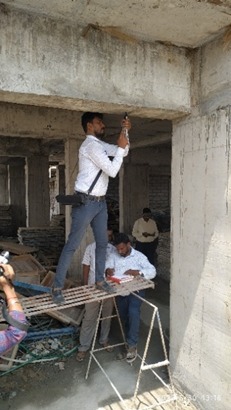
Rebound Hammer
Verifies the surface hardness of concrete elements using elastic rebound principles to estimate immediate compressive strength.
Detects low surface hardness, uniformity issues, and potential weak skin concrete zones.
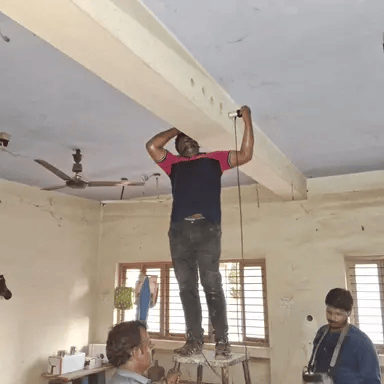
Ultrasonic Pulse Velocity (UPV)
Sends electro-acoustic transducers pulses through concrete blocks to calculate sound speed and trace concrete density.
Locates internal air voids, structural honeycombing, internal cracks, and structural discontinuity.
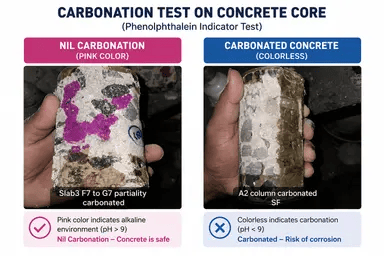
Carbonation & Chloride Tests
Applies chemical indicators (phenolphthalein) to broken cores to examine chemical depth penetration and concrete pH levels.
Identifies loss of steel rebar alkaline protection, indicating high risks of premature internal rust.
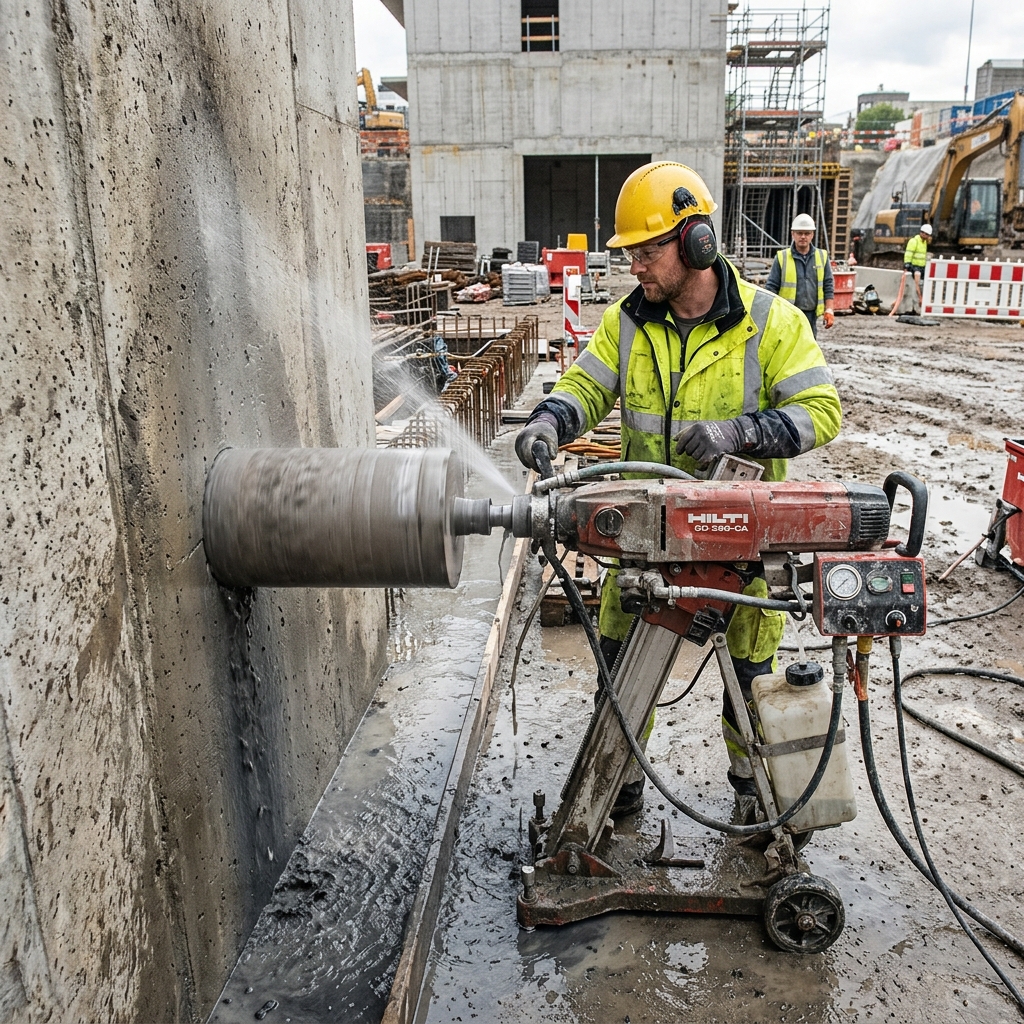
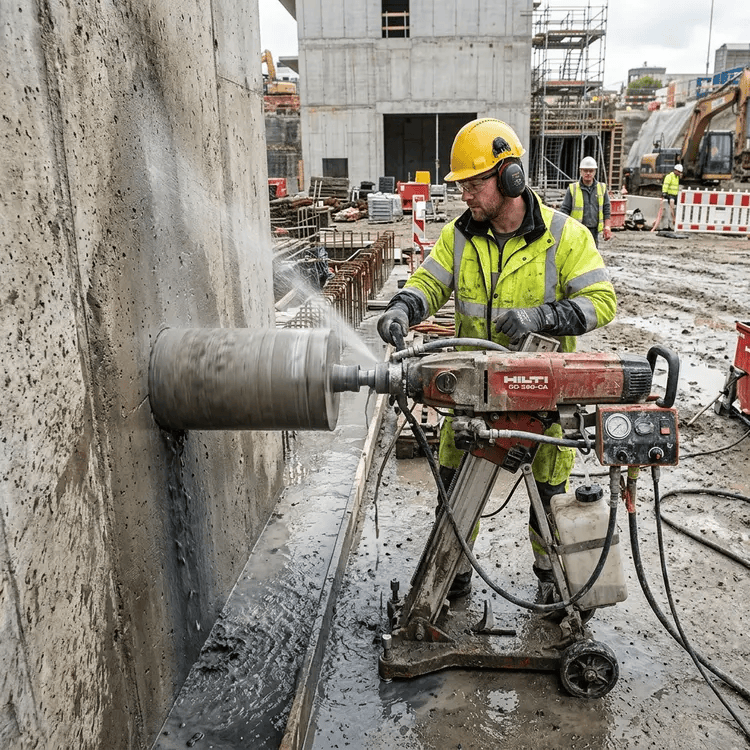
Concrete Core Drilling
Drills out physical cylindrical cores from concrete elements to perform laboratory crushing strength tests.
Verifies exact in-situ compressive strength, concrete consolidation, and aggregates layout.
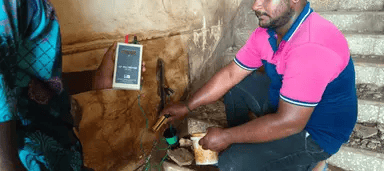
Half-Cell Potential
Measures electrical potential gradients across concrete reinforcements using reference electrodes to map electrical currents.
Determines the active corrosion probability of embedded steel bars before visual cracking occurs.
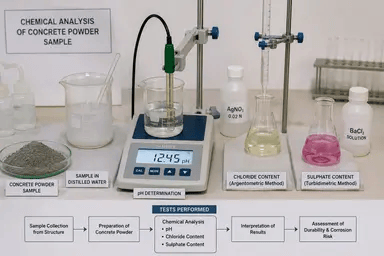
Chemical Analysis
Performs qualitative chemical extractions on mortar/concrete dust to evaluate sulfate and chloride levels.
Detects internal chemical attack hazards, aggregate reactivity issues, and soil/water salt poisoning.
Ready to Vet Your Next Project?
Ensure safety, compliance, and material integrity. Contact our senior advisory panel to discuss your structural requirements today.
Request a Structural Audit
Visual inspections, crack mapping, and load stability certifications matching corporation bylaws.
Request Audit →Schedule a Site Visit
Arrange for senior engineers to audit concrete pouring, formwork layout, or reinforcement covers on site.
Schedule Visit →Speak to an Engineer
Consult on concrete mix designs, restoration schemes, carbon wrapping, or material laboratory testing.
Consult Now →